German vocabulary in context.
Nine illustrated vocabulary topics covering everyday German — each word presented with its article, meaning and a real example phrase so it sticks in context, not in isolation.
 Learn German vocabulary free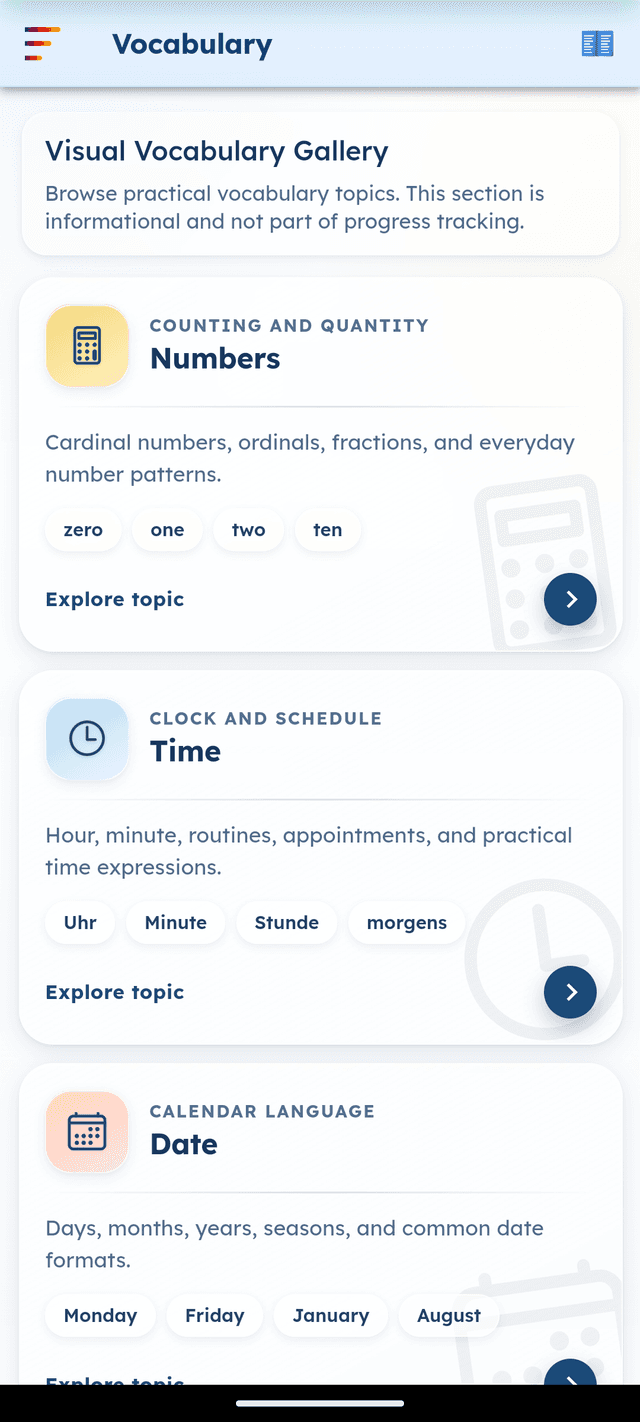
Vocabulary is the raw material of language. Without enough words, grammar rules have nothing to operate on. But isolated word lists are one of the least effective ways to build vocabulary — words stick when you learn them in context, with their article, in a real sentence. GermanVault's visual vocabulary section organises the most useful everyday German words into nine thematic topics, each built for contextual learning.
Numbers (Zahlen)
German numbers follow regular patterns but have a few quirks — notably that in compound numbers the unit comes before the tens ("drei und zwanzig" for 23). GermanVault covers cardinal numbers, ordinal numbers (erste, zweite, dritte…), and the patterns you need for prices, phone numbers, and dates.
Time and Dates (Zeit und Datum)
Telling time in German has formal and informal variants — "Es ist viertel nach drei" vs "Es ist 15:15". Dates require ordinal numbers and the correct preposition ("am dritten März"). GermanVault covers both with example sentences showing natural usage.
Family (Familie)
Family vocabulary is among the first you need at A1 level. GermanVault covers immediate family (Mutter, Vater, Schwester, Bruder), extended family (Oma, Opa, Tante, Onkel, Cousin), and relationship terms — each with its grammatical gender (der/die/das) and a usage example.
Body Parts (Körperteile)
Body vocabulary is essential for medical situations, describing people, and common idiomatic expressions. GermanVault covers head-to-toe vocabulary with the correct article for each noun — a detail that many vocabulary lists omit but that is essential for correct sentence construction.
Food, Animals, Nature and Clothes
The remaining five topics cover Animals (Tiere), Nature (Natur), Food (Essen), and Clothes (Kleidung) — all organised by theme with example phrases. Food vocabulary is especially useful for real-life situations like shopping, ordering in a restaurant, and reading menus.
Why context matters for vocabulary
Seeing "Hund — dog" in a list is less memorable than reading "Der Hund läuft schnell" (the dog runs fast). GermanVault includes example phrases for every word so you see each item in a meaningful sentence, which significantly improves long-term retention compared to flashcard-style rote memorisation.
Frequently asked questions
What vocabulary topics are in GermanVault?
Numbers (Zahlen), Time (Zeit), Dates (Datum), Family (Familie), Body Parts (Körperteile), Animals (Tiere), Nature (Natur), Food (Essen), and Clothes (Kleidung) — nine illustrated topics in total.
Does each word include its grammatical gender?
Yes. Every noun in GermanVault's vocabulary section is presented with its article (der, die, das) because gender is inseparable from correct German grammar.
Can I quiz myself on vocabulary?
Yes. The GermanVault quiz feature includes a Vocabulary topic so you can test yourself on any of the nine vocabulary areas.
Is the vocabulary feature free?
Yes. All nine vocabulary topics are free in GermanVault.
What level is the vocabulary content aimed at?
The vocabulary topics are primarily A1–B1 level, covering the everyday words you need for conversation and exams. They form a solid foundation before you move on to topic-specific vocabulary for your field or region.
Ready to master German?
Download GermanVault free on Android. No account required.
