How Germans actually speak.
Go beyond textbook German with authentic slang expressions used by native speakers — each one explained with its meaning and real-world context.
 Learn German slang free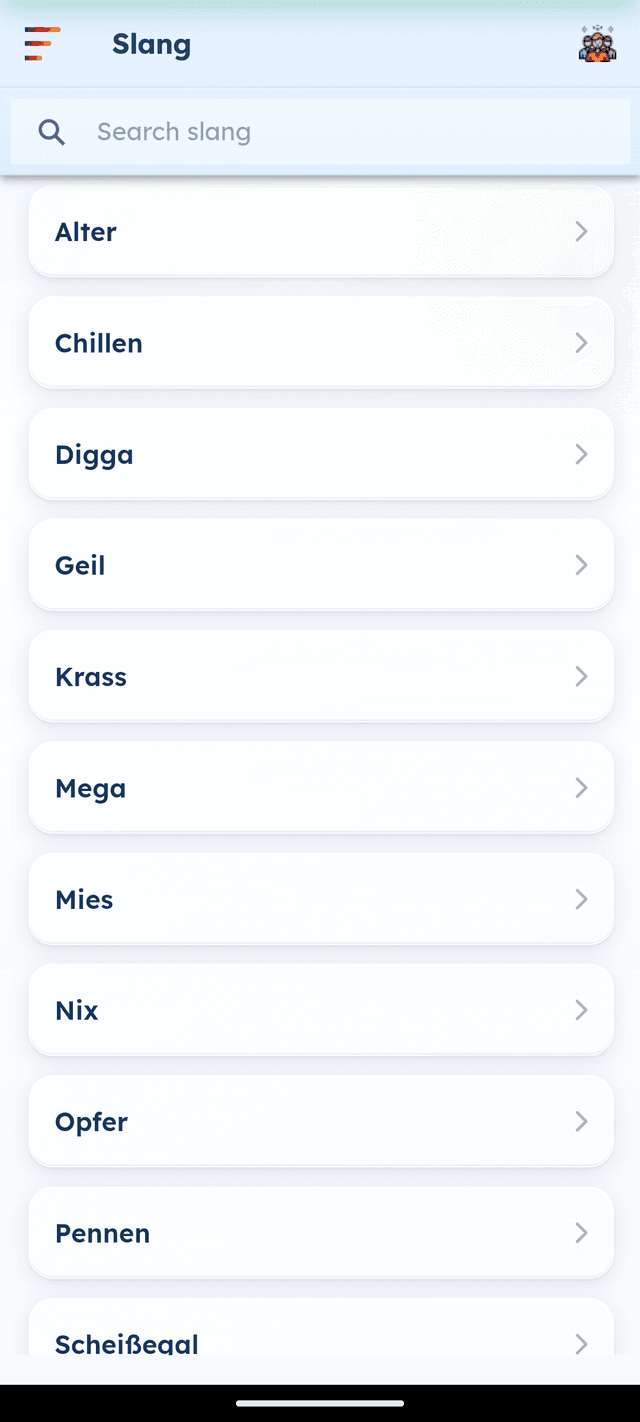
If you've ever watched a German film, listened to a German podcast, or spoken with native German speakers and felt lost despite your textbook knowledge, slang is likely the gap. German slang changes quickly and is rarely covered in formal courses. GermanVault gives you a dedicated slang library that bridges the gap between classroom German and the real thing.
What is German slang?
German slang (Umgangssprache) is informal language used in everyday speech — typically casual, often younger-skewing, sometimes regional. Words like "krass" (intense, extreme), "geil" (awesome, literally means something crude but is used positively in modern German), "Alter" (dude, mate), and "chillen" (to chill) are ubiquitous in conversation but missing from most textbooks.
Each expression in context
Every slang entry in GermanVault includes the German expression, its English meaning, and at least one example showing how it's actually used in natural speech. This context is essential — many slang terms have connotations that a bare translation misses.
Know when and where to use it
Slang is register-sensitive. Using it with friends is natural; using it in a job interview or formal email is not. GermanVault's slang explanations include notes on formality and context where relevant, so you know not just what a term means but when it's appropriate.
Searchable and offline
Search for any slang term instantly. Results appear as you type, even offline after the first load.
Slang vs idioms
GermanVault keeps slang and idioms in separate sections. Idioms are fixed, register-neutral phrases used across formality levels. Slang is inherently informal and often generational. Knowing the difference helps you use each appropriately.
Frequently asked questions
What are common German slang words?
"Krass" (intense, extreme, crazy), "geil" (awesome, cool), "Alter" (dude, mate), "Digga" (buddy — Hamburg dialect), "chillen" (to chill/relax), "mega" (very, extremely), "Mies" (bad, rubbish).
Is German slang the same across Germany, Austria and Switzerland?
No. German slang varies significantly by region. Berlin, Hamburg, Bavaria, Vienna and Zurich all have distinct colloquialisms. GermanVault covers broadly-used standard German slang.
Should I learn German slang as a beginner?
You can start any time. Knowing basic slang from A2/B1 helps you understand native speakers in informal settings even before you're fully fluent. Just be aware of register — slang is for casual contexts.
Is the slang section free?
Yes. The full slang library is free in GermanVault.
Can slang help with German exams?
Understanding slang improves listening comprehension, which is tested in CEFR exams from B1 upwards. Native-speaker audio clips and authentic dialogue often include informal expressions.
Ready to master German?
Download GermanVault free on Android. No account required.
