How We Gamified German Word Order: Inside the Satzbau-Spiel
There's a specific kind of frustration that German learners know well. You sit down, study the word order rules, feel like you've got it — and then the moment you try to use them in a real sentence, everything scrambles. The verb ends up in the wrong spot. The separable prefix stays glued to the front. The infinitive should be at the end but your hand is already moving somewhere else.
Knowing a rule and being able to use it without thinking are two completely different things. The Satzbau-Spiel — German for "sentence building game" — is our attempt to help you get from one to the other faster. Here's how it works and what we were thinking when we designed it.
What the game looks like
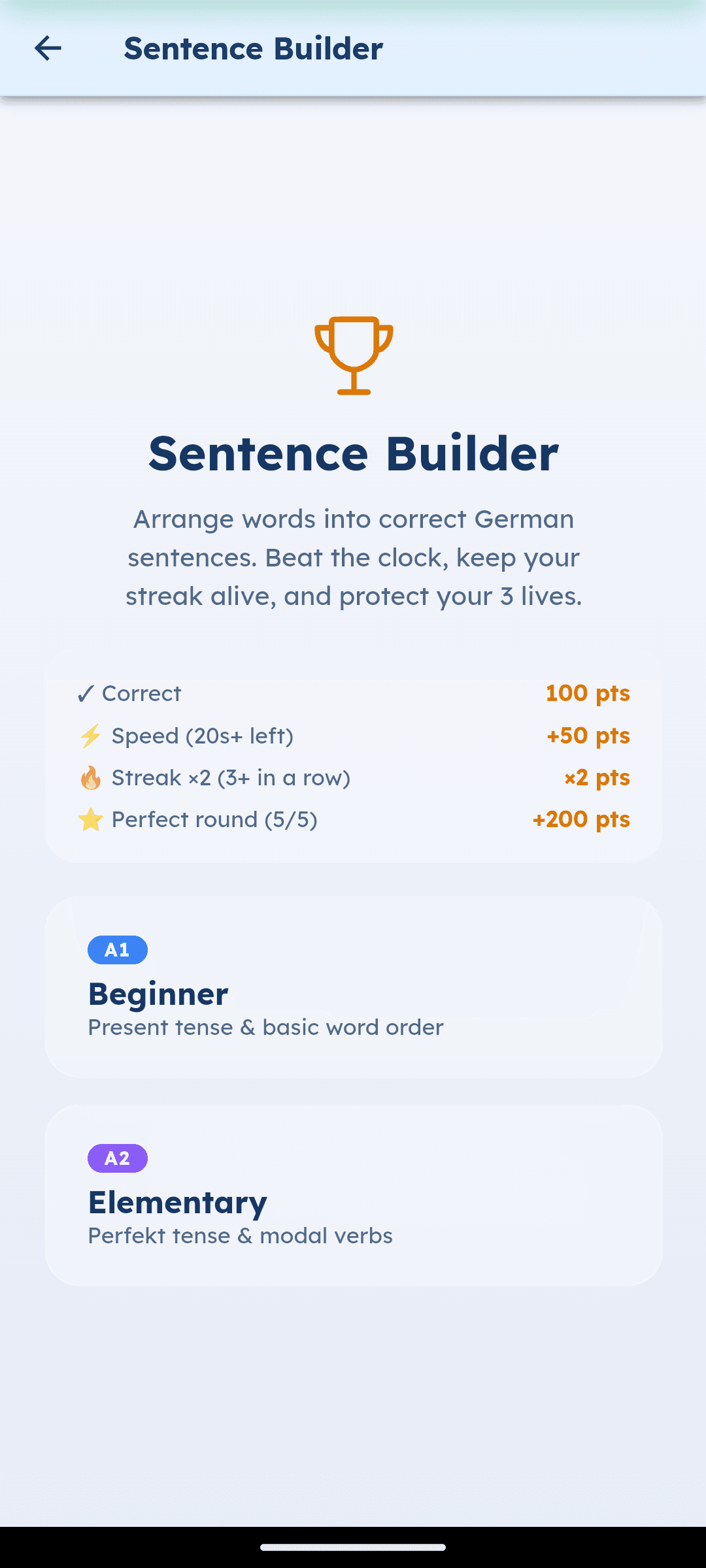
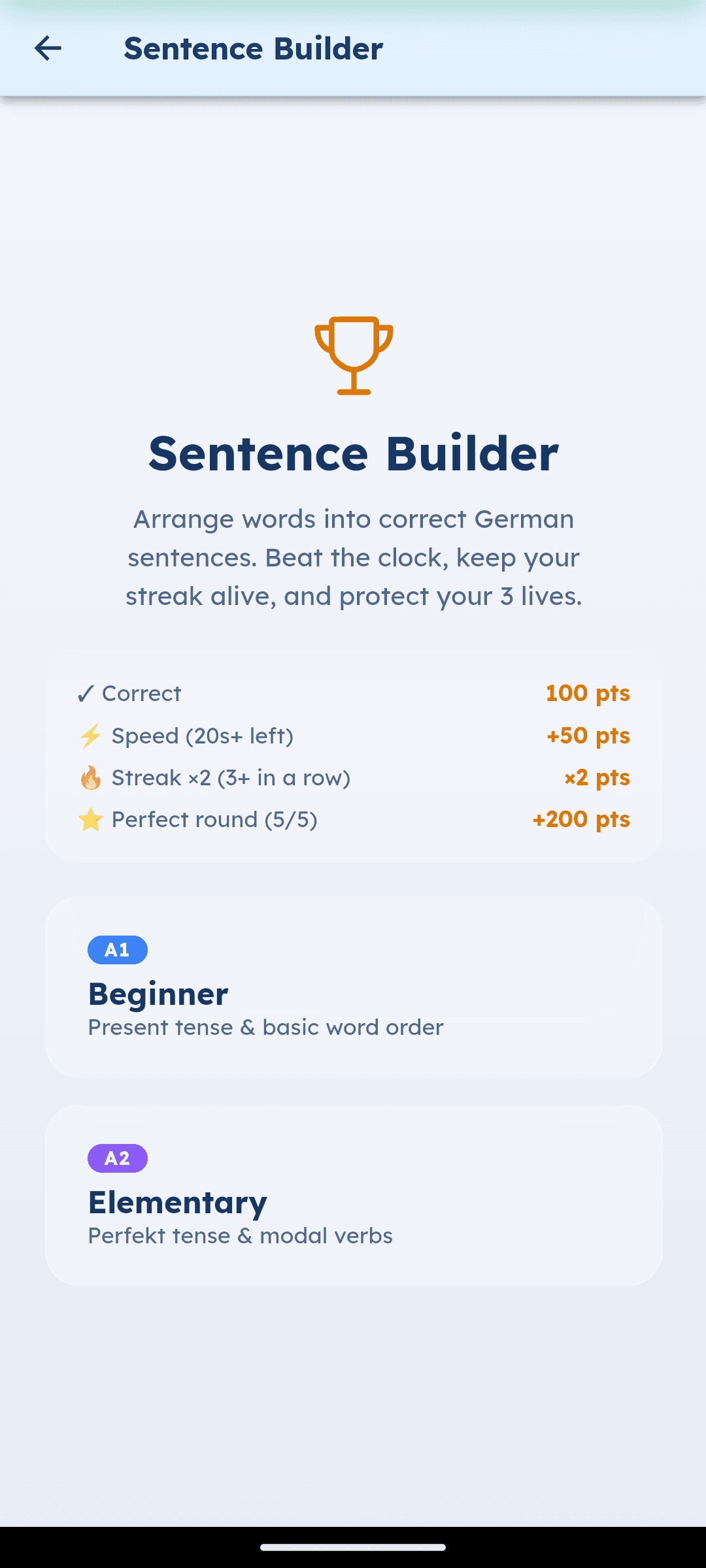
Pick your level, read the scoring breakdown, and go. Each round is five sentences.
You open the game and choose a level — A1 for basic present-tense sentences, A2 for more complex constructions involving the Perfekt tense and modal verbs. A short countdown appears, then the first sentence drops in front of you.
The words are shuffled and arranged at the bottom of the screen as individual tiles. Your job is to tap them into the correct German order before the 30-second timer runs out. When you think you've got it, you hit submit.
Five sentences make a round. You carry three lives across all five. A wrong answer or a timeout each cost one. Lose all three and the round ends early. Keep going and you see your score summary at the end.
Why a countdown instead of unlimited time?
This is probably the most common question we get about the game. Why the pressure? Why not let people think it through?
The short answer: the game isn't meant to be where you learn the rules. That's what the Grammar section is for. The Satzbau-Spiel comes after — it's the practice ground where you take rules you already understand and make them faster and more instinctive.
When you have unlimited time, it's easy to succeed by consciously walking through the grammar step by step. That's useful while you're first learning. But fluency means not needing to do that walk-through at all. The timer creates just enough pressure to push you past deliberate thinking and toward genuine recall. Over time, getting the verb into second position stops being a rule you apply and starts being something you just feel.
Thirty seconds per sentence is more generous than it sounds. For sentences you know well, you'll be done in under ten. For sentences you're still working out, the full thirty is there.
How scoring works
Getting an answer right earns you 100 points as a base. Submit with more than 20 seconds still on the clock and you pick up an extra 50 — a speed bonus for answers that came quickly and confidently.
String two correct answers together and the multiplier kicks in: every point you earn doubles. A fast correct answer on a streak is worth 300 points. Without the streak it would be 150. Keep the streak going and the points climb fast — which is satisfying in its own right, but also a useful signal. High scores tend to mean the sentences felt natural, not laboured.
Get all five correct in one round and a 200-point bonus lands at the end. It's a nice reward for a clean run.
One small note: the scoring hint on the level-select screen says the streak multiplier starts at 3 in a row. It actually starts at 2. The screen is wrong — we'll fix it in an upcoming update.
Getting it wrong
The screen flashes red, you lose a life, and the game moves on to the next sentence fairly quickly. The idea is to keep the rhythm going rather than stop and dwell on the mistake.
The best way to avoid repeating the same error is to visit the relevant Grammar topic before playing. If modal verbs keep catching you out, reading through that section first — which explains why the infinitive sits at the end of the sentence — will make the game click in a way that trial and error alone won't.
Confetti at four out of five
Finish a round with four or more correct answers and confetti fires across the screen. Not five — four is the threshold.
We set it there deliberately. If confetti only appeared on a perfect round, most people would rarely see it, and it would start to feel like something that happens to other people. At four out of five, it's genuinely within reach after a few solid sessions with the grammar. It gives you something worth chasing without making perfect the only goal.
Where the game fits in your learning
The Satzbau-Spiel works best as a follow-up to the Grammar section, not a replacement for it. Read through the word order rules in Grammar first — the explanations are there, with examples and tables. Then use the game to make those rules feel automatic under a bit of pressure.
A1 is the right starting point for most learners. The sentences focus on main clause structure: verb in second position, subject and object around it. Once that feels reliable, A2 adds the Perfekt tense and modals, which introduce two-verb constructions and change where the second verb lands.
B1 content — subordinate clauses, relative pronouns, the Konjunktiv II — isn't in the game yet. It's the most-requested addition. When it arrives, the sentences will be meaningfully harder: verb-final constructions, clauses within clauses, the kind of thing that trips up even confident B1 speakers. We're looking forward to building it.
Give it a try
You'll find the Satzbau-Spiel inside GermanVault under Grammar → Sentence Builder. The A1 level takes about two minutes per round and is a reliable test of whether your present-tense word order is actually solid, or whether it only holds up when you're not being timed.
Most people find it harder than they expect the first time. That's usually a good sign — it means there's something worth practising.
GermanVault is free on Android — no account needed to start.
Open on Google Play